



🧬 When "Free" Isn't a Kickback: Why OIG Approved This Diagnostic Testing Program
By: Dr. L.A. Stanton
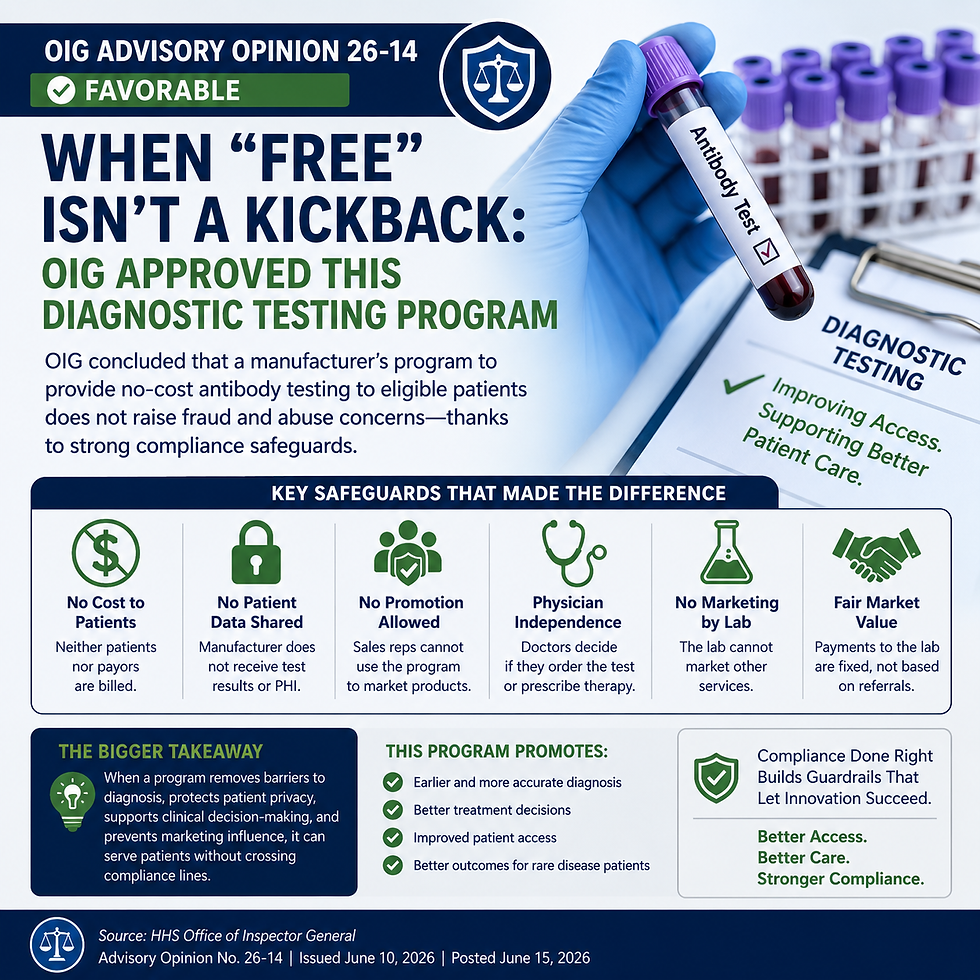
Healthcare Compliance Insight | OIG Advisory Opinion 26-14
The Office of Inspector General (OIG) recently issued a favorable advisory opinion that offers healthcare providers, laboratories, and pharmaceutical
manufacturers valuable guidance on how patient access programs can be designed without crossing compliance boundaries.
What's the Story?
A pharmaceutical manufacturer proposed paying for free antibody testing for patients who may have a rare neuromuscular condition. The test helps physicians determine whether patients may be candidates for the company's FDA-approved medication.
At first glance, providing free testing sounds like it could raise Anti-Kickback concerns. Surprisingly, the OIG agreed the arrangement technically involved remuneration—but determined that the overall compliance safeguards reduced the fraud and abuse risk enough that it would not impose sanctions.
Why Did OIG Say "Yes"?
Unlike many manufacturer-sponsored programs, this arrangement was carefully engineered to support clinical decision-making—not product promotion.
Several safeguards stood out:
✅ Patients paid nothing for the diagnostic test, and neither Medicare nor private insurers were billed.
✅ The manufacturer never received patient-specific test results or physician-identifying information.
✅ Sales representatives could not use the program as a marketing tool or discuss the company's drug while promoting the testing program.
✅ Physicians remained completely independent in deciding whether to order the test or prescribe any therapy.
✅ The laboratory was prohibited from marketing other services through the program.
✅ Payments to the laboratory were based on fixed, arm's-length fees rather than referral volume.
The Compliance Lesson
This opinion reinforces an important principle:
Not every free healthcare service creates compliance risk.
The deciding factor is why the service exists and how it is managed.
When a program is designed to remove barriers to diagnosis, improve access to medically appropriate care, protect physician independence, and prevent the use of patient data for marketing, regulators may view the arrangement as serving patients rather than influencing referrals or prescribing decisions.
The Biggest Win
Perhaps the most significant aspect of this opinion is OIG's recognition that improving access to care can outweigh potential fraud and abuse concerns when strong compliance controls are in place.
The agency acknowledged that:
Rare diseases are frequently misdiagnosed.
Physicians may not be familiar with available diagnostic testing.
Earlier diagnosis can improve treatment decisions.
Removing financial barriers to appropriate testing can benefit both patients and the healthcare system.
What Healthcare Leaders Should Ask
Before implementing any free testing, screening, or patient assistance program, consider:
✔️ Is the program genuinely improving patient access?
✔️ Can clinical decisions remain completely independent?
✔️ Are marketing and sales teams separated from patient-level information?
✔️ Are vendor payments based on fair market value instead of referral generation?
✔️ Could regulators view this as supporting patient care rather than influencing utilization?
KLS Solutions Compliance Perspective
This Advisory Opinion demonstrates that effective compliance is not about saying "no" to innovation—it's about designing innovation responsibly.
Organizations that embed transparency, physician independence, patient privacy, and strong governance into new programs are far more likely to withstand regulatory scrutiny.
The best compliance strategy doesn't stop innovation—it builds the guardrails that allow innovation to succeed.
Source: HHS Office of Inspector General, Advisory Opinion No. 26-14 (Issued June 10, 2026; Posted June 15, 2026).


Comments